
Review based on a production Nikon D40
Auto Focus only for AF-S or AF-I lenses
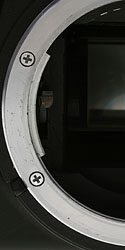
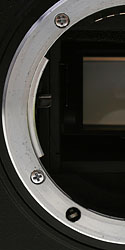
Perhaps the biggest negative on the D40 is that it doesn't have an internal focus drive motor and hence no mechanical focus drive pin, instead it only has CPU contacts which means it can only Auto Focus with AF-S and AF-I lenses (those with built-in focus motors). Indeed our 'standard' lens the Nikkor 50 mm F1.8D (and the F1.4D) are manual focus only on the D40. The images below show the difference between the mount on the D40 and D80, the D80 has a mechanical focus drive pin at about the 7 o'clock position. |  |
Key features
- 6 megapixel DX format CCD (1.5x FOV crop, as D50)
- Nikon Image processing engine (as D80 / D200)
- 3D Color Matrix Metering II, 420 pixel sensor (as D80 / D50)
- New Multi-CAM530 three area AF sensor
- ISO sensitivity range 200 - 1600 plus HI 1 (3200 equiv.)
- Custom Auto ISO (selectable maximum ISO, minimum shutter speed)
- 2.5 fps continuous shooting (as D50), unlimited in JPEG
- No status LCD, new LCD monitor based status / settings screens
- Help suggestions on LCD monitor (eg. scene too dark, try using flash)
- Large 2.5" 230,000 pixel LCD monitor
- Bigger viewfinder view (x0.8 magnification, 95% coverage)
- Short shutter lag and viewfinder blackout
- Support for SDHC (SD cards over 2 GB in capacity)
- In-camera retouching
- D-Lighting (shadow / highlight enhancement)
- Red-eye reduction
- Trimming
- Monochrome
- Filter effects
- Small picture
- Image overlay
- USB 2.0 with PTP and Mass Storage device support
- Very compact, light body (smaller, lighter than D50)
- Improved menu user interface (as D80 / D200)
- New EN-EL9 Lithium-Ion battery (7.2V, 1000 mAh)
- New 'Version II' AF-S DX 18-55 mm kit lens
Compared to the Nikon D50, major feature and specification differences
Nikon's choice of "compromises" with the D40 are switching to a new three area AF sensor (although it seems to be just as fast), removing some of the flexibility (you can't change the CW average area, exposure steps are fixed at 1/3 EV and there's no bracketing) and removing the status LCD (although this has more to do with making the camera smaller than saving money). What the D40 shares with the D50 are some of the important things, the six megapixel sensor, the 420 pixel metering sensor (also used on the D80), the more 'consumer like' default IIIa color mode and 2.5 frames per second continuous shooting (although now unlimited in JPEG mode).On the plus side you get ISO 3200 equiv. (HI 1), the ever useful customizable Auto ISO, a larger viewfinder view, shorter shutter lag and viewfinder blackout, a larger LCD monitor, a considerably nicer user interface, SDHC support, a new image processing engine, unlimited JPEG continuous shooting, in-camera retouching (including D-Lighting) and of course a smaller and lighter body. It would not therefore be fair to describe the D40 as a 'dumbed down' D50, far from it, the range of improvements and new features out-weigh those which have been removed or reduce, which would most likely not be missed by the average D40 owner.
 Nikon D40 |  Nikon D50 | |
|---|---|---|
| Introduction price | $599 (Kit) | $899 (Kit) |
| Autofocus | • 3 area TTL • Nikon Multi-CAM530 • Only AF-S or AF-I lenses | • 5 area TTL • Nikon Multi-CAM900 |
| CW Avg. size | 8 mm | 6, 8, 10, 13 mm or frame average |
| Exposure steps | 1/3 EV | 1/3 or 1/2 EV |
| Sensitivity | • ISO 200 - 1600 • Up to ISO 3200 with boost (HI 1) | ISO 200 - 1600 |
| Auto ISO | • Selectable maximum ISO • Selectable minimum shutter speed | On/Off |
| Bracketing | None | • Exposure • White balance |
| Built-in flash | Guide number 17 (ISO 200) | Guide number 15 (ISO 200) |
| Continuous | • 2.5 fps (1 fps at ISO 3200) • Unlimited / 9 frames (JPEG / RAW) | • 2.5 fps • 12 / 4 frames (JPEG / RAW) |
| Image presets | Normal, Softer, Vivid, More Vivid, Portrait, B&W | Normal, Vivid, Sharper, Softer, Direct Print, Portrait, Landscape |
| Viewfinder | • Penta-mirror type • Eyepoint: 18.0 mm (at -1.0 m-1) • Frame coverage 95% (approx.) • Magnification approx. 0.8x • B-type Bright View Clear Matte Mark V | • Penta-mirror type • Eyepoint: 18.0 mm (at -1.0 m-1) • Frame coverage 95% (approx.) • Magnification approx. 0.75x • B-type Bright View Clear Matte Mark V |
| LCD monitor | • 2.5" TFT LCD • 230,000 pixel TFT | • 2.0" TFT LCD • 130,000 pixel TFT |
| Status LCD | No | Yes |
| Storage | SD / SDHC card | SD card |
| Battery | Lithium-Ion EN-EL9 (7.4 V, 1000 mAh) | Lithium-Ion EN-EL3a (7.4 V, 1400 mAh) |
| Dimensions | 126 x 94 x 64 mm (5.0 x 3.7 x 2.5 in) | 133 x 102 x 76 mm (5.2 x 4.0 x 3.0 in) |
| Weight | • No battery: 471 g (1.0 lb) • With battery: 522 g (1.2 lb) | • No battery: 540 g (1.2 lb) • With battery: 620 g (1.4 lb) |
| Programmable FUNC button | Yes | No |
| In-camera retouching | • D-Lighting • Red-eye reduction • Trimming • Overlay • Monochrome and Filter • Small picture • Image overlay | No |
| World time | Yes | No |
| Kit lens | AF-S DX 18-55 mm F3.5-F5.6 G II | AF-S DX 18-55 mm F3.5-F5.6 G |
Foreword / notes
If you're new to digital photography you may wish to read some of our Digital Photography Glossary before diving into this article (it may help you understand some of the terms used).Conclusion / recommendation / ratings are based on the opinion of the author, we recommend that you read the entire review before making any decision. Images which can be viewed at a larger size have a small magnifying glass icon in the bottom right corner of them, click to display a larger image in a new window.
To navigate this article simply use the next / previous page buttons or jump to a specific page by using the drop-down list in the navigation bar at the top of the page. You can support this site by ordering through the affiliate links shown at the bottom of each page (where available).
This article is protected by Copyright and may not be reproduced in part or as a whole in any electronic or printed medium without prior permission from the author.
Dpreview use calibrated monitors at the PC normal gamma 2.2, this means that on our monitors we can make out the difference between all of the grayscale blocks below. We recommend to make the most of this review you should be able to see the difference (at least) between X,Y and Z and ideally also A, B and C.
Nikon D40x Overview
by Dave Etchells and
Shawn Barnett
Review Date: 6/29/07
Shawn Barnett
Review Date: 6/29/07
The Nikon D40x has a sensor resolution of 10.2 megapixels, and offers
ISO sensitivity ranging from 100 to 1,600, with the ability to extend
this to ISO 3,200 using the Hi-1 setting. Even though the sensor
resolution has been increased from six megapixels in the original D40
model, the ten megapixel D40x offers a faster burst mode of three frames
per second. The D40x retains the same compact size, portability and
ease-of-use as its popular sibling, the D40.
The D40x has a 2.5" LCD display with 230,000 pixel resolution and a
170 degree viewing angle, which means your friends can gather 'round
behind you and everyone will see the same image quality wherever they're
standing. Other D40x features include extensive in-camera image
editing, a full array of automatic and manual exposure modes, including
some modes tuned for specific situations, like Portrait, Landscape,
Child, Sports, Close up and Night portrait. There's an Auto ISO mode
that lets the user select the maximum ISO and minimum shutter speed,
which leaves you with some control over what Auto can do. Just like the
D40, autofocus is only supported when using AF-S or AF-I lenses, which
limits you to newer Nikon lenses. The built-in i-TTL flash has a guide
number of 12m /39 ft. at ISO 100 in auto modes and 13m / 42 ft. in
manual. Maximum flash sync is 1/200 second.
The D40x uses an EN-EL9 lithium-ion rechargeable battery, with a
rated 520 shots per charge, and stores images on SD/SDHC memory cards
(not included). Connectivity includes USB 2.0 high-speed, A/V out, and
the option of an infrared remote.
The Nikon D40x started shipping in April 2007, priced at $729.95 body
only, or $799.95 bundled with an 18-55mm f/3.5-5.6G ED II AF-S DX
Zoom-Nikkor lens.
Nikon D40x User Report
by Shawn Barnett
Nikon out-flanked the competition last Fall with the introduction of
the six-megapixel D40, a small, easy-to-use digital SLR with good
quality at an affordable price. They fairly bracketed the competition,
namely Canon's Digital Rebel XTi, with the Spring 2007 introduction of
the Nikon D40x, a 10-megapixel digital SLR with the same ease of the
D40, but with resolution to match the XTi.
This is my favorite kind of review to write, because the D40x is an
excellent camera, easy to recommend. The D40x is so similar to the D40
that I'll be re-editing some of my former descriptions from the D40
review, as the form and function are essentially the same (to summarize:
terrific in almost every aspect).
What's new. Physically, only the badge on the D40x is
different from the D40. Internally, it has a 10 megapixel sensor instead
of 6. The new sensor brings a few other changes thanks to its different
technology.
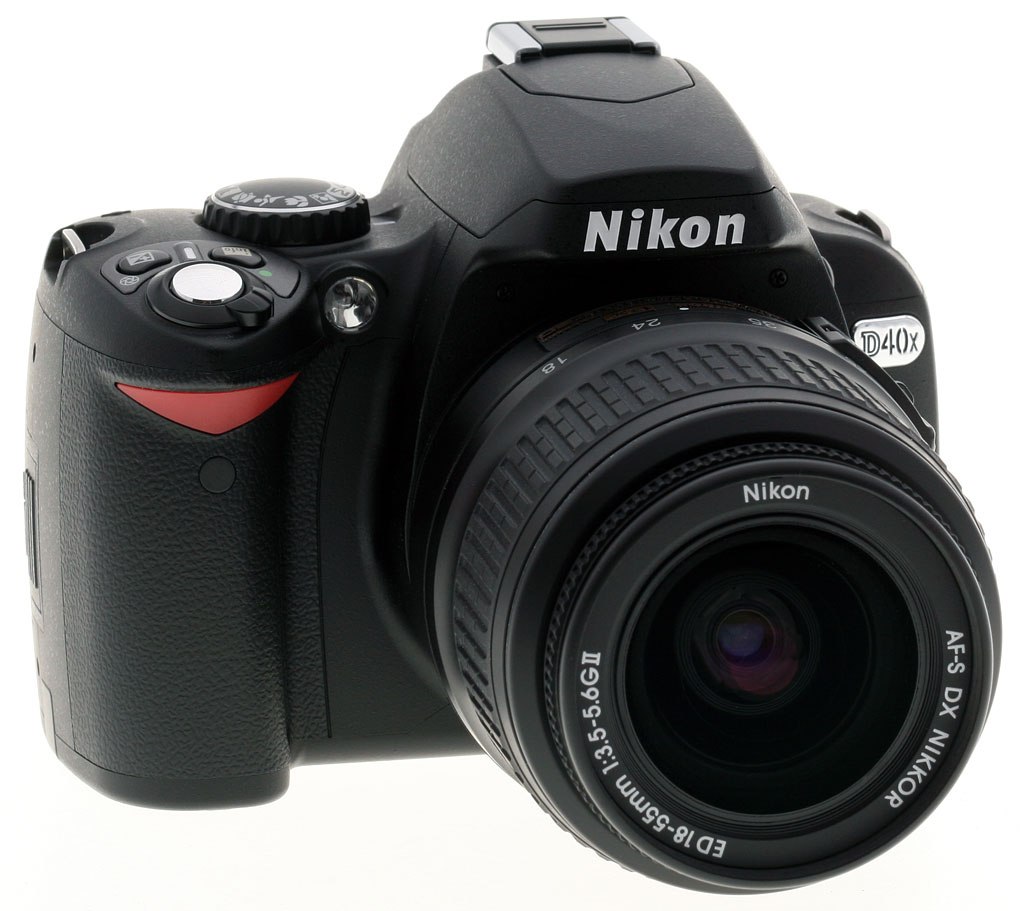 First,
the flash sync speed goes down to 1/200 from 1/500. This same change
occurred between the D70 and D80. In both cases, the reason is that
Nikon switched from "gating" the CCD at higher shutter speeds to
including a faster shutter mechanism. This change reduces the chance of
"blooming" in images where a bright highlight like the Sun in the frame
can overload the sensor. For more on this, see the Exposure tab.
First,
the flash sync speed goes down to 1/200 from 1/500. This same change
occurred between the D70 and D80. In both cases, the reason is that
Nikon switched from "gating" the CCD at higher shutter speeds to
including a faster shutter mechanism. This change reduces the chance of
"blooming" in images where a bright highlight like the Sun in the frame
can overload the sensor. For more on this, see the Exposure tab.
Second, the Nikon D40x is capable of a slightly faster 3.0 frames
per second in continuous mode, as opposed to the D40's 2.5 frames per
second.


Two advantages. Going from 6 to 10
megapixels means more pixels are dedicated to a given element, which is
why they appear larger when displayed pixel-for-pixel. The other
advantage here is the D40x's lowest setting of ISO 100, whereas the D40
is limited to 200. I should note, however, that the D40 does such an
excellent job that it's hard to see a significant difference.
Third, the ISO range now includes 100, instead of just 200-3,200.
The main advantage here is that you can achieve slower shutter speeds or
wider apertures in bright light than you'd be able to with the D40.
Theoretically you might also get better noise control with the new
sensor at ISO 100, but the D40's noise performance is so good that I
can't see a difference, and can't imagine anyone else would.
Unlike a move from 8 megapixels to 10 megapixels, the jump from 6 to
10 megapixels is indeed a large one. Enlarge both images to 100 percent
onscreen, and you can see just how much larger objects are. It turns
out this is an excellent way to gauge how much more detail you're
getting. Your screen resolves at only one resolution, so if you set both
images to match, you can see how much detail you have in each image.
I've done it for you to the right. The top image is from the D40, the
bottom from the D40x. If you're not going to be doing a lot of cropping
or enlarging beyond 11x14, you won't notice much difference between the
D40 and D40x except the average file size. I would be happy with either,
but our tests do show that the D40x has greater dynamic range than any
camera we've tested. More on that later in this report, and on the
Imatest page.
Finally, the Nikon D40x's image buffer doesn't go on forever like
the D40 can when capturing JPEG images. Instead, depending on the
subject, it fills after about seven shots when set to Large/Fine JPEG.
Compatibility. There is one point that owners of older Nikon
lenses should know right up front: The D40x was designed to work
primarily with AF-S lenses and AF-I teleconverters. The Nikon D40 and
D40x are built specifically for entry-level consumers, and abandon
compatibility with the majority of Nikon's older AF lenses. This is the
key important distinction that everyone, especially enthusiasts, should
know about the D40 and D40x. Though you can still mount old lenses and
focus manually, most older lenses require a body-based screw-drive
mechanism that the D40s lack. I maintain that this was a wise move on
Nikon's part to help keep the price low and the camera small, but I have
occasionally missed that compatibility, especially when wanting to
mount a prime (non-zoom) lens on this pleasantly small SLR. There are
currently no short prime Nikkor lenses available in AF-S. (I now carry a
small SLR with a 50mm prime attached as my everyday camera; I prefer
the low light performance and reduced depth-of-field possible with such
an arrangement.)
Those who still want to use legacy lenses in autofocus mode, many of
which are still in the Nikon lineup, should opt for the D50, D70, or
D80. Note that you can still use older lenses with the Nikon D40x if
you're okay with manual focus. The D40x can still control aperture on
lenses marked D and G, and it will illuminate the AF points when an area
is in focus. For more complete detail on this relatively complex issue,
see the Optics section of this review.
 |
 |
| Nikon D40x | Nikon D200 |
|
What's missing from the D40x is the physical
coupling you see on the Nikon D200's mount at right. This makes the D200
compatible with lenses that use Nikon's 20-year-old AF drive mechanism.
Compatibility's great, but the old system does make more noise than the
AF-S system used by the D40x.
|
|
I think it's a safe bet that most Nikon D40x owners will prefer the
quieter, more modern AF-S lenses that are currently 23 in number, plus
three teleconverters.
Manners. Not since the days of cloth focal plane shutters have
I heard such a soft shutter sound as we get with the D40 and D40x.
Nikon has been getting better and better at this aspect of their SLR
cameras, and the D40 line surpasses them all. It's not critical to have a
nice soft shutter sound, but it does much to foster appreciation among
users, and even subjects. Harsh clacking and winding is really more
distracting than appealing. A softer sound allows the photographer to be
part of the background rather than the center of attention. One
exception to this rule is when photographing models, when it's helpful
for the model to know when to change poses, but that's far from the
Nikon D40's intended market.
The Nikon D40's pop-up flash is fairly quiet too, releasing with a
single "clack;" more tame than the Canon Rebel XTi's far louder
"zing/clunk." It can be released manually via the button on the left of
the lens mount, or automatically by the camera when in fully automatic
modes.
The Nikon D40's 18-55mm AF-S lens also focuses very quietly, thanks
to its Silent Wave Motor. I found it a very useful and reliable lens.
Coupled with the D40x's excellent high ISO performance in low light, its
f/3.5 maximum aperture wasn't such a limitation.

Noticable flare, quite strong in direct sunlight at the 18-55mm's telephoto setting when there's significant contrast in the corners.
As I noted with the D40's kit lens, the Nikon D40x's 18-55mm
f/3.5-5.6G ED II AF-S kit lens exhibited noticeable lens flare in high
contrast objects out toward the corners. I think it's perfectly
acceptable in a lens at this price point, but still worthy of note. Also
an option for a little more money is a kit that bundles the more
versatile Nikkor 18-135mm lens that was first bundled with the Nikon
D80. This lens has its own problems in terms of increased chromatic
aberration, but it's still an excellent choice for general purpose
photography. Not only can you do more in terms of cropping as you
capture, it's a better quality optic overall.
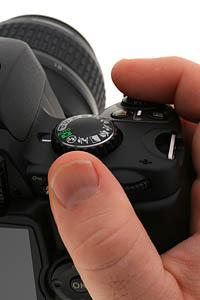
Comfortable grip.
Experience. Gripping the Nikon D40x is like settling down in
your favorite chair. Not only do you feel right at home, the chair feels
at home with you, having formed itself to match your shape. The Nikon
D40x already matches. My index finger finds the shutter release
perfectly, and the remaining three fingers fit quite well around the
grip. Though I wouldn't mind a slightly deeper grip, this is quite good
for a camera this small, and a slight recess gives my fingertips a good
place to settle, offering tactile feedback that tells me I have
sufficient purchase on the camera. My thumb finds its special notch high
up on the D40x's back, right between the AE-Lock button and the Command
dial. It's just a minor nudge to either of these controls, just like
picking up my drink from the side table without taking my eyes off the
book as I sit in that comfortable chair. Effortless.
Thumb dial.
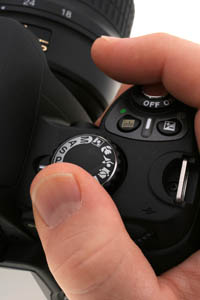
Rather than use the good quality knurl around the Mode dial, I found
myself most often sliding my thumb up to spin the Nikon D40x's Mode dial
to my next setting. It's easier to move it in a counterclockwise
direction, and easy enough to go all the way around, so that's my normal
mode. The top of the dial isn't flat, but domed, and it has a texture
that my thumb finds easy to grip.
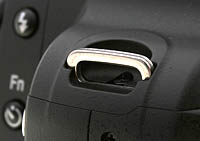
Recessed strap loops.
Since I seldom use camera straps, the lashing points on the camera
often bother me, jutting out into my hand or swinging around as they
often do. But the strap loops on the Nikon D40x are recessed into the
camera body on both sides, a welcome change from all past Nikon DSLR
designs, which either flop and rattle on the pro end or jab into your
hand on the consumer side.
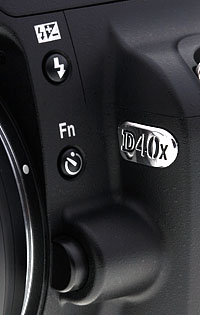
Function button. As I did with the D40, I set the D40x's Function button to ISO, which I change most often.
Controls. The Nikon D40x's control layout is simple and easy
to adapt to. I even like the position of the Function button. This is a
button you can reprogram to bring up your most frequently adjusted menu
item. I currently have it set to ISO. Just press the Function button on
the side of the lens with your left thumb and turn the Command dial. The
status display lights up the Fn box and you can see the ISO numbers
ramp up or down.
Easy adjustments.
A good many other essential items are shown on the Nikon D40x's
Status display, and can easily be controlled with only a few more
buttons. Just press the Zoom/info button, and select the icons across
the bottom or right side of the screen with any of the four arrow
buttons on the Multi selector. When you reach the one you want, hit the
OK button in the center of the Multi selector and a menu is displayed
with photographic examples for the various modes. Make your selection
and press the OK button again. You're ready to shoot with your new
setting. The example shots are very much like those we've seen on
consumer digicams over the past few years, and it is appropriate to see
them here on the Nikon D40S, an SLR aimed at consumers.
LCD. The screen is a big, bright 2.5 inch display with a wide
viewing angle in all directions to help you show off your pictures. The
camera is so small that the screen seems to dominate the Nikon D40x's
back panel.
I'm overjoyed to see that there's no silly snap-on screen protector
in the Nikon D40x box. They fog up, add two extra surfaces to reflect
glare, and just bug me. I'm told the screen cover is good for protecting
the screen from shirt button scratches. My usual nylon buttons don't
mar anything, but I suppose harder buttons might. To this day, however,
I've never even seen a scratched LCD display on an SLR; so just be
aware, use the care you should with your fragile photographic tool, and
you should be able to maintain a scratch-free LCD cover glass with
little trouble.
Most SLR manufacturers have ditched the additional monochrome LCD in
favor of using the main color LCD as a status display on their consumer
SLRs. About half have also recognized that it helps to have the LCD turn
off when you put the camera to your eye. Nikon is not among that half.
The Canon Rebel XTi and Sony A100 have IR sensors in place to detect
your face against the viewfinder so that the screen shuts off. The Nikon
D40x and Olympus E-510 just keep the LCD on until you half-press on the
shutter button. It's not a big problem in good light indoors or out,
but when it gets dark, it's a nuisance, one that gets worse if you have
glasses. The glare just bounces around in that optical mess. If you half
press the shutter, however, the Status display goes off. It comes back
on about a half second after your release the shutter. You can release
the Nikon D40x's shutter only halfway and keep shooting with the same AF
setting, and the LCD does not come back on.
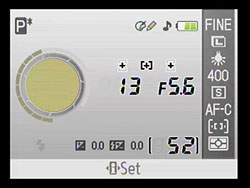
Graphic display.
If you like, you can turn off the D40x's status display, which Nikon
calls the Shooting Information Display. On by default, it goes off after
a few seconds at idle, to save batteries, and comes back on when you
press the Info button behind the Shutter release button. You can choose
among three displays, and pick different ones when in PASM vs full-auto
and Scene modes. The Graphic display is set by default. It shows a wheel
in the left corner that represents a shutter speed dial and aperture
display. The aperture display "stops down" to approximate what the lens
blades will be doing, but it only moves after several turns of the
Command dial. The same goes for the shutter speed graphic. It seems like
a good idea to educate those who are unfamiliar with how cameras work,
though they'll have to be the types to pay close attention. You can also
have your own picture there as a backdrop in Wallpaper mode. For the
most part, I prefer the Classic display, with its no-nonsense, bold
digital display of the important data. It looks essentially like the
monochrome Status LCDs you'll find on semi-pro and pro SLRs.
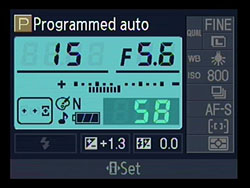
Classic display.
Regardless of the display chosen, the LCD is slow to refresh as you
change settings. That includes aperture, shutter speed, and EV (exposure
value) settings. This is a problem from the D40 that hasn't been fixed
in the D40x. I found myself particularly frustrated with the EV
settings, because I frequently overshot my goal, thinking the camera had
missed my input. When attempting to set -1/3 EV, for example, the
camera wouldn't make the change, so I'd turn the Command dial again.
Then the camera would catch up and move it to -2/3. The LED display in
the optical viewfinder doesn't have this problem, however, moving
instantaneously to reflect your choice. This is an unfortunate bug that
makes using EV adjustment and manual modes with the Nikon D40x
difficult.
Optical viewfinder. Luke, the lab technician, and I both found
the diopter control difficult to set. We also noticed that the D40x
didn't adjust for our eyesight well enough (which isn't unusual for me).
Rather than the wheel Nikon used on the D200 and D80, the D40x has a
slider next to the rubber eyepiece. Changing it while looking through
the viewfinder is cumbersome, and you frequently slide past your desired
setting due to the force necessary to move it in the first place.
The viewfinder display is very good, showing all the important
information, including which AF point is selected, and there's a little
question mark icon that flashes in low light or any other situations the
Nikon D40x thinks you should make an adjustment. To see what's up, just
pull the camera from your eye and press the question mark button on the
left of the LCD display. Here in my office, it usually says, "Lighting
is poor; flash recommended." I think that's a good feature to have in a
consumer camera, and the note's not condescending. What I don't like is
the incessant flashing of the question mark in the viewfinder and on the
back LCD when I'm trying to do something unconventional. It's not a big
deal, though, just a rant, and one enthusiasts might want to make note
of: the D40x's help feature just might bug you.
AF points. Praise the designers for putting bright LED
brackets on all three of the D40x's AF points. Even the excellent Nikon
D80 still has the very cool looking, but too often worthless LCD/faint
LED combo. I prefer a bright red LED to tell me where the camera is
focusing, as exists on the entire Canon SLR lineup. These are big,
obvious brackets. And yes, there are only three, but I'm really not as
jazzed as I used to be about multiple AF points. I more frequently lock a
camera to its center point and work from there. The center point is
usually more accurate, and I find that SLRs just aren't as accurate as
digicams have been at guessing what I want in focus.
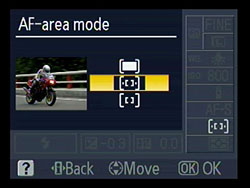
There is one small problem related to AF points and the Nikon D40x's
size. As I mentioned, I prefer to lock it to the center AF point, but
putting the D40x into Single Area mode is the only way to set this.
Unfortunately, you can't exactly lock it to the center point; instead
you use the left and right arrows on the Multi-controller to select
which AF point you want to use. Because the area for your thumb on the
D40x is small, I find I accidentally press the left and right arrows on
the Multi controller, changing the default AF point. That's a bit of an
unwelcome surprise when you raise the camera to your eye for a quick
candid portrait and the D40x focuses on the subject's belt. Most users
will do better to leave the D40x in Closest subject or Dynamic area
modes.
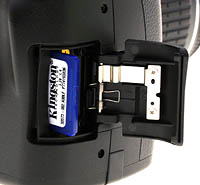
Solid SD card door.
Doors and latches. The Nikon D40's SD card door opens with a
firm slide to the rear, then it swings open under power of a good stiff
spring. A rubber bumper softens and quiets its impact. I prefer this
design to others that just flop around loose.
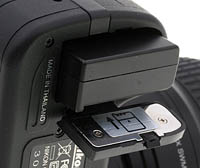
Stronger springs hold the battery in place.
Nikon also improved the battery door and its retention spring. The
Nikon D70 and D80 had weak, mushy springs on their latches, and could
open if you pressed in the just the wrong way on the bottom of the
camera. Not so with the D40x. The spring is firm. Once that door is
open, the battery seems to slide right out. But it emerges to about 3/8
inch where it stops. This is just enough for you to grab the battery and
pull it out the rest of the way. I noticed that the battery of the D70
and D80 were halted in the same way, but it was a thin wire that did the
arresting. I wondered how long that would last. On the Nikon D40x, the
arresting is done by a wide bit of spring steel. That should last
longer.
I've also found the battery life to be quite good, enduring several
days of regular shooting. According to CIPA standards, the Nikon D40x's
1,000 mAh EN-EL9 is good for about 470 shots on a single charge, and the
manual says it'll recharge from empty in 90 minutes. Still, I recommend
a second battery. It's a drag to be without your camera while you wait
for the battery to charge; and it usually dies when you need it most.
The best news, though, is that most lithium-ion batteries can sit
charged for a long time (often a month or so) and still be good when you
need them.
Flash. It's a small step down that the D40x doesn't have the
D40's 1/500 second flash sync, especially since neither camera supports
FP mode. As I mentioned, the reason the D40x doesn't have this speedy
x-sync is because they've put in a full-speed shutter mechanism, rather
than relying on electronic "gating" of the sensor array.
Put simply, gating a sensor means that you're making the exposure by
opening the shutter completely, then turning the sensor on and off at
the speed you desire. In the case of the D40, the maximum gate speed is
1/4000 second. But why is the flash sync speed reduced on the D40x?
Because to make a flash exposure, the shutter must be completely open
while the flash fires, and the fastest speed that allows this is 1/200
second. At 1/250, the second curtain of the focal plane shutter has
already started closing before the first one fully opens, so when the
flash fires, part of the sensor will be covered by one or other of the
shutters. So between 1/250 and 1/4000 second, the shutter never fully
opens, and is instead an increasingly narrow slit that travels across
the sensor. (There is often a way to overcome this with external
flashes, which pulse as the slit travels across the sensor, but the
D40x's on-camera flash is not capable of this FP, or Focal Plane mode,
nor does it support external units in FP mode.)
The other missing component to the D40x's flash picture, shared by
the D40, is its inability to serve as a Commander in the Nikon Advanced
Wireless Lighting System. Mount an SB-800, and that limitation can be
overcome, but you'd do better to purchase a Nikon D80 if you want to
employ the Nikon Advanced Wireless Lighting System, because each SB-800
will run about $320-$400.

High ISO makes backlit indoor shots easy.
Image quality. It's the Nikon D40x's excellent image quality
that makes recommending this little digital SLR so easy. See the
Exposure and Optics tabs for the detailed breakdown. I'm most impressed
that they were able to improve on the D40's already stellar high ISO
performance. Hoping to catch my son napping in the afternoon this week
like I did when I reviewed the D40 last Fall, I instead found him up and
watching a movie with his brother. It was a good moment, so I pressed
the Function button to select ISO 1,600, extended the 18-135mm lens to
75mm, and snapped off a few shots handheld. It's no great art, but it's a
cute picture of two brothers cooling off on the futon after playing one
hot Summer afternoon. This is just the kind of photo most D40x owners
want from their new camera: a candid indoor shot without flash. It's a
little soft and grainy, but still natural looking. With the 18-55mm kit
lens, I'd have had to move closer, which would have distracted them from
their gaze. That's why I strongly recommend the 18-135mm kit if you can
afford it. Equivalent to a 27 to 202mm lens, the 18-135mm lens is
bigger, but it's better, and has just the right reach for almost all
family photography. When I reviewed the D80, I've never felt more
instantly at home with a camera and lens combination. Shooting at an
amusement park, I could go wide for the scenics and then set up for a
head and shoulders portrait from just about any vantage.

Saturation. Colors are quite vibrant at the default Normal setting.
Looking at my images after shooting most of the Gallery shots, I was
surprised how saturated the colors were. I had to check the camera to
verify that I had it set to Normal; I did. Dave and I agree that both
the contrast and saturation on the D40x's Normal setting are set too
high for our purposes, but that most consumers will be pleased. Their
reality will be just a little more punchy and beautiful, and that's what
most folks want to see. Those interested in making their own
after-capture tweaks to the image will do better entering Custom mode
and making their own mix of settings.

55-200mm VR. Sharp edge-to-edge, easy to handhold.
I also had the sweet little Nikkor 55-200mm VR lens with me, which
was introduced at PMA 2007 concurrent with the Nikon D40x. Available for
between $240 and $300, this lens seems like another great choice for
the D40x owner seeking a little extra reach with help from optical image
stabilization. It's equivalent to an 82.5-300mm lens on a 35mm camera,
yet is both small and light. We haven't tested it on SLRgear.com yet,
but the shots I got with it seem pretty sharp corner-to-corner.
At full telephoto indoors or shade, the AF system is slower to
acquire focus with the 55-200mm VR, which I expected. The image
stabilizer is sometimes jittery starting up, making a little buzzing
sound, but it stabilizes quickly. I don't think this is Nikon's best VR
system, as it often seems unable to compensate for my movement when set
to full tele, but it's still nice to have the extra help.
One other plus with the Nikon D40x that we found when we ran our
Imatest "deep analysis," which we usually reserve for SLRs, is its quite
superior dynamic range. It actually delivers better highlight and
shadow gradation in its JPEG images than all other cameras we've tested,
including the remarkable Fujifilm S3 Pro. This latter camera has a
sensor that's specially designed to produce a wide dynamic range,
blending the results from high-sensitivity and low-sensitivity pixels,
so the fact that the D40x beats this purpose-built pro camera is
significant. Looking at the images side-by-side, we tended to prefer the
D40x's output as well. When it came to analyzing the RAW output from
both cameras, the S3 Pro did edge the D40x slightly; but it beat
everything else on the chart. What does that mean for you? Well, it
means you're more likely to get both the white wedding dress and black
tuxedo exposed properly in the same shot; and if you don't, you're more
likely to be able to recover some detail from these areas if you need
to. Both shadow and highlight detail will be more rich and have more
depth, where other cameras will just transition from gray to black in
one or two steps.
See the Optics and Exposure tabs for the rest on the D40x. In short,
though, the D40x is a camera you can buy with confidence and be sure
you'll love the pictures.
Comparisons.
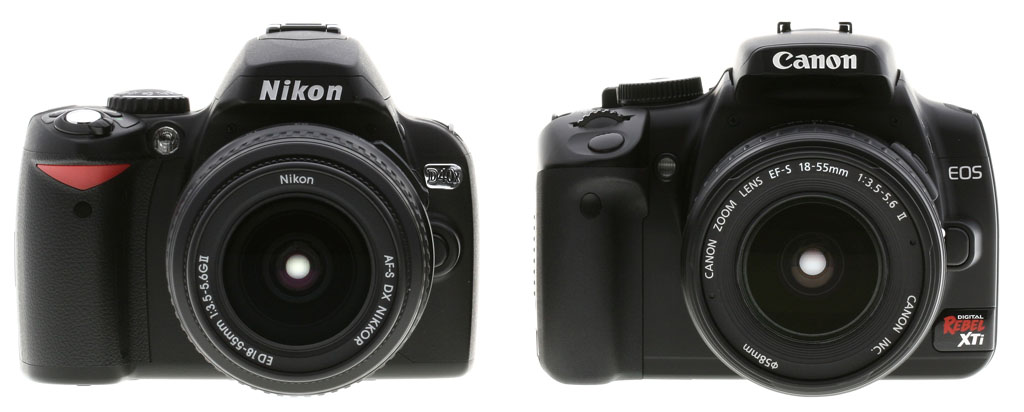
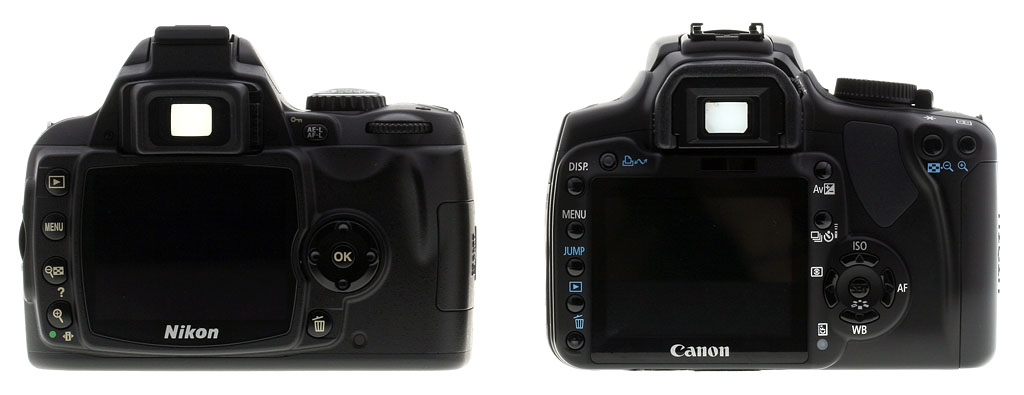
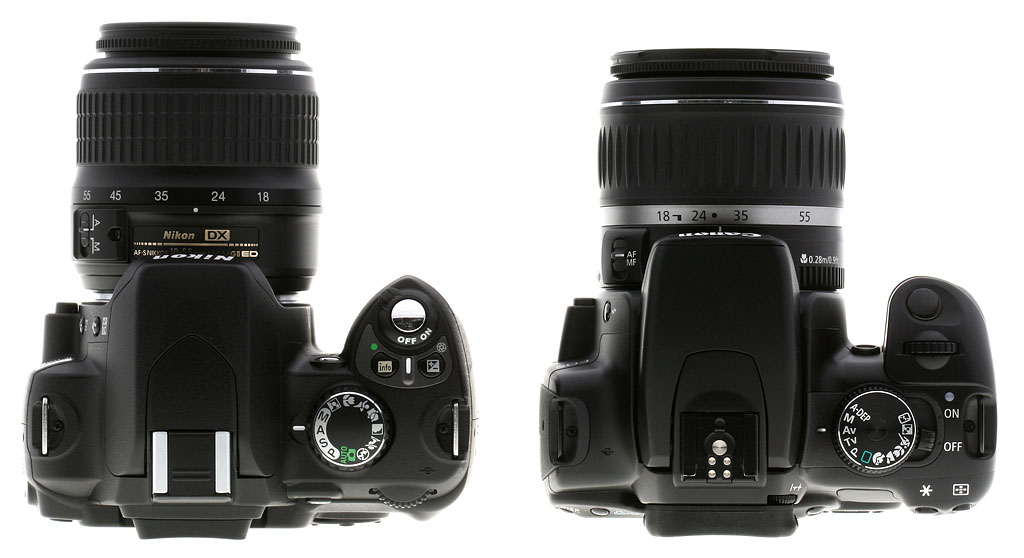
Which is smaller? A side-by-side comparison shot makes the Nikon D40x appear smaller than the Rebel XTi from the front. Their dimensions are actually almost identical. In millimeters: Nikon D40x: 126 x 94 x 64mm, Canon Rebel XTi: 126.5 x 94.2 x 65mm. Weight is also only slightly different, with the XTi coming in just 9 grams heavier than the D40x's 753 grams (26.5 ounces) with lens, cap, battery, and card. In the second image, you can see the D40x's simpler control array, while the XTi is more cluttered with buttons and labels. As a more experienced photographer, I like more buttons, but I think it's too easy for inexperienced photographers to accidentally change a setting on the XTi and ruin a whole day's worth of photos. Note also that the camera and lens combination of the D40x is a little longer than the XTi.
Since I reviewed the D40, the list of competing cameras in this
small, family category has increased a bit. Now there's the Olympus
E410, which is even smaller than the D40x and XTi. We haven't finished
our testing of that little SLR, though, so I can't comment much.
The Canon Digital Rebel XTi has a fit rival in the Nikon D40x,
though, that is for sure. Major differences are more technical, and have
less to do with image quality. The grip of the Nikon D40x is a little
taller and deeper, the lens build is a little better, and the controls
are simpler. The D40x's built-in AF-assist lamp is quite a bit better
than the XTi's pulse flash alternative, and its tough to beat the D40x's
soft shutter sound. But the XTi also has its strengths, including an IR
sensor that turns of the LCD Status display when you raise the camera
to your eye, better low-light AF performance from its 9-point AF array,
and full compatibility with Canon's entire line of EOS lenses dating
back to 1989. Its dust removal system is probably a wash, since you'll
have to clean both sensors eventually regardless.
In terms of image quality, you'll get great shots from either
camera. At their default settings, the Canon Rebel XTi is surprisingly
more conservative in terms of saturation and contrast, but that
distinction can be found compared to the D80 and D50 as well. The D40x
also offers ISO 3,200, one stop more than the XTi will deliver. Below
I've cropped from our Still Life shots taken at ISO 1,600 to give a
closer look at the two approaches to high ISO images. Both will make
great prints and deliver a lot more than any digicam (non-SLR) of
comparable resolution, so what you see below does not take away from the
overall quality that both cameras capture.
 |
 |
 |
 |
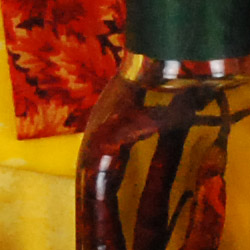
Different approaches. Here
at ISO 1,600, the highest that the XTi and D40x have in common, you can
see the two different approaches to maintaining a quality image at high
ISO settings. On top you have the Canon XTi, and below the Nikon D40x.
Different eyes will see each image differently. The XTi takes a more
conservative approach, leaving some noise in place in favor of
maintaining detail. The D40x did just like its big brother the D80 did,
squashing as much noise as possible in favor of cleaner, more decisive
colors. You can see the shadow on the right behind the Mas Portell
bottle has more random colors, or chroma noise, in the Canon image than
in the Nikon sample. Meanwhile, the details in the letters on the Canon
image are a little better defined than the D40x, and the left shoulder
of the bottle is stippled rather than smooth. In the left image, color
and contrast are more pumped in the Nikon image, which tends to reveal
the anti-noise processing around the edges of the peppers. Likewise, the
orange leaves on the cloth in the background are brighter, but with
less tonal range than in the Canon image. Most photographers who
post-process their images on a computer would be drawn to the Canon
XTi's images, because they have software that can make more of the image
than the Nikon D40x's software did. But truthfully, the Nikon D40x
image will print a little better, appearing more bold and sharp up to
about 11x14.
|
|
Appraisal. The Nikon D40x is a gem. Consumers should want
one, intermediate photographers should want one, and pros would do well
to carry one too. The Nikon D40x is one of the finest family cameras on
the market made even better than its predecessor, which is a tall order.
As I said with the D40, I've really enjoyed shooting with the D40x,
and would seriously consider it as a second camera to something like a
D80, D200, or 30D. Those cameras are great for more serious work, but
they're also bigger and heavier. The D40x is a camera for capturing fun
and family. It's crafted for such duty. And you can still slap high
quality glass on it and shoot with the pros anytime you like. The Nikon
D40x is perfect for slipping into a small daypack for a hike or picnic.
It doesn't take a lot of space, and it comes out of the bag quickly. It
focuses and shoots so quietly, you're less likely to scare the animals
you're trying to capture.
Intermediate photographers wanting a camera to start a business on a
budget should look to the Nikon D80 or Canon 30D, as these are more
suited for professional photography. Those who already own a bagful of
Nikon glass should look instead to the D80 or D200, because they'll want
to use that fine Nikkor equipment as long as they can. But if you're
just getting started in SLR photography and want a light, sweet,
competent, and simultaneously friendly digital SLR, the Nikon D40x is a
superb choice.
In the Box
The Nikon D40x kit ships with the following items in the box:
- Nikon D40x body
- Lens AF-S DX Zoom-Nikkor 18-55mm f/3.5-5.6G ED II
- Body cap
- Front lens cap
- Camera strap
- Eyepiece cap
- Rubber eyecup
- USB cable
- Quick charger (MH-23)
- AC power cord
- Li-ion battery (EN-EL9)
- Accessory shoe cover
- Lens cap
- PictureProject CD ROM
- Quick start guide
- Instruction manual
- Warranty and registration card

0 comments:
Post a Comment